1914–1986
Kateryna Zarytska
Head of the underground Red Cross
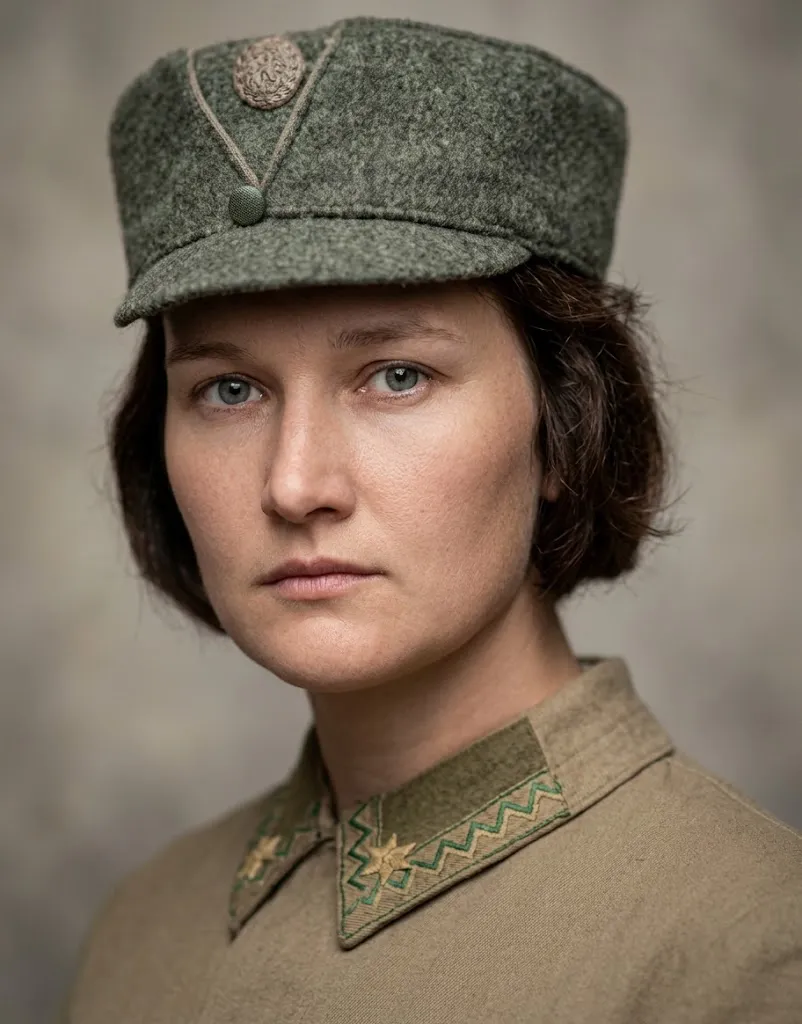
Why did prisoners of many nations in Vladimir Central Prison silently salute a woman at a laundry window? Kateryna Zarytska had led the underground Ukrainian Red Cross, served as Roman Shukhevych’s courier and spent about 30 years behind bars.
Key accomplishments
- Led the underground Ukrainian Red Cross (1943–1945)
- Personal courier of UPA commander-in-chief Roman Shukhevych (1945–1947)
- Wrote underground articles and pamphlets under the pen name “U. Kuzhil”
- Silver Cross of Merit of the UPA
A salute from the laundry window
Vladimir Central was a Russian prison for those the Soviet authorities considered especially dangerous. When a work gang was led out, the prisoners passed the window of the prison laundry. A tall woman with greying hair stood there and greeted them. And all of them, Ukrainians and Lithuanians, Jews and Russians, Moldovans and Armenians, silently took off their caps or saluted. That is how a former prisoner from Leningrad, Anatol Radygin, remembered it. The woman was Kateryna Zarytska.
A professor’s daughter in the underground
Kateryna was born in 1914 in Kolomyia, the daughter of the mathematician Myron Zarytskyi. In 1930, while still at school, she joined the youth network of the Organization of Ukrainian Nationalists (OUN), an underground movement fighting for an independent Ukraine. In 1934 the Polish police arrested her: she had helped a militant linked to the assassination of the Polish interior minister Bronisław Pieracki escape abroad. She was tried together with Stepan Bandera and other OUN members. She got 8 years, later cut to 4.5.
In 1939 Kateryna was released and married Mykhailo Soroka, also an OUN member. The next year the Soviet authorities arrested them both. In Lviv’s Brygidky prison Kateryna gave birth to her son Bohdan, who later became a well-known graphic artist.
A Red Cross in hiding
From November 1943 to the spring of 1945 Zarytska ran the underground Ukrainian Red Cross in four Galician regions. She set up hospitals for wounded OUN members and fighters of the Ukrainian Insurgent Army (UPA), and found doctors and medicine for them. She then became the personal courier of UPA commander-in-chief Roman Shukhevych: she found safe houses for him and passed on his instructions. Under the pen name “U. Kuzhil” she wrote articles and pamphlets.
On 21 September 1947 she was arrested in Khodoriv. The next year a court gave her 25 years, and she served every one of them: in the Verkhneuralsk and Vladimir prisons, and from 1969 in a camp in Mordovia. After her release in 1972 she was barred from living in Western Ukraine, so she settled in Volochysk, where she died in 1986.
Debates and assessments
Zarytska’s path is part of the history of the OUN and the UPA, which is still judged in very different ways. In the 1930s the OUN used political assassinations, and the Polish court convicted Zarytska precisely for her part in such cases: helping a militant after Pieracki’s murder and watching people the organization planned to kill. When she was arrested in 1947 she fired back and wounded an officer of the MGB, the Soviet secret police. Decades later, Soviet propaganda was still describing her articles as “full of zoological hatred for everything Soviet”.
Why she is remembered
Lviv has a Zarytskykh Street, named after Kateryna and her father, and streets in Kolomyia and Volochysk bear her name. In 1991 she was reburied beside her husband in Lviv’s Lychakiv Cemetery. A Plast scout unit in Lviv is named after her.