1906–1942
Olena Teliha
Poet and OUN activist
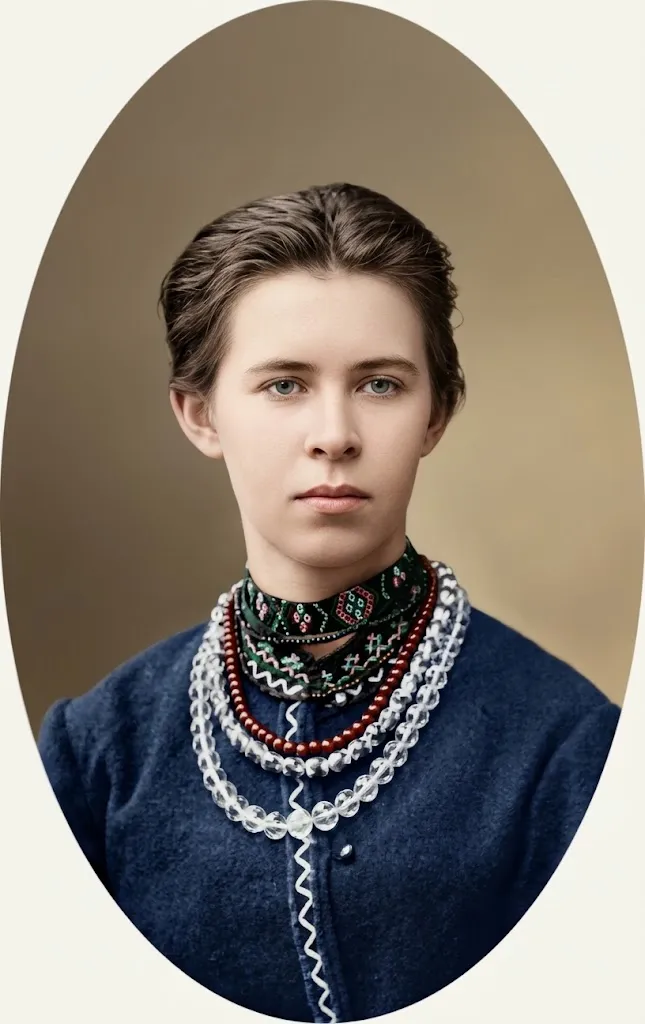
“That dog’s language is my language!” By her own account, that is what a poet raised among Russian speakers shouted at a party in Prague in 1934. From then on Olena Teliha spoke only Ukrainian. In 1941 she headed the Writers’ Union in Kyiv; in 1942 the Nazis executed her.
Key accomplishments
- Poems and essays in Dmytro Dontsov’s journal Vistnyk (from 1933); the posthumous collection The Soul on Guard (1946)
- Headed the Zarevo literary and artistic society in Cracow (1939–1941)
- In 1941, in occupied Kyiv, headed the Union of Ukrainian Writers and edited the literary weekly Litavry
“That dog’s language is my language!”
Olena Shovheniva was born in 1906 in the village of Ilyinskoye near Moscow, into the family of the hydraulic engineer Ivan Shovheniv (as given by the Encyclopedia of the History of Ukraine; the Canadian Internet Encyclopedia of Ukraine gives 1907 and Saint Petersburg). In 1918 the family moved to Kyiv, and in 1922 to Poděbrady in Czechoslovakia. Olena grew up in a Russian-speaking environment, and as she wrote in 1928, she had known Ukrainian only “very recently”.
In 1934, at a party in Prague, someone began mocking the Ukrainian language. By her own account, printed in Vistnyk, Olena stood up, banged her fist on the table and shouted: “That dog’s language is my language!” From then on, she wrote, she spoke only Ukrainian.
A poet of Vistnyk
In 1923–1929 Olena studied at the Ukrainian Higher Pedagogical Institute in Prague, and in 1926 she married Mykhailo Teliha. In 1929–1939 the Telihas lived in Warsaw, where she taught at a Ukrainian school. From 1933 she published poems and essays in Dmytro Dontsov’s journal Vistnyk, and she saw the Ukrainian woman as an equal participant in the struggle for independence. In December 1939 Teliha joined the OUN and in Cracow worked with Oleh Olzhych in its cultural section, heading the Zarevo arts society.
Kyiv, 1941
On 22 October 1941 she arrived in Nazi-occupied Kyiv with the OUN expeditionary groups. There Teliha headed the Union of Ukrainian Writers and edited Litavry, the literary and arts supplement to the newspaper Ukrainske Slovo. According to the Encyclopedia of the History of Ukraine, she saved the poet Yakiv Halperin from arrest. When the occupation authorities closed Ukrainske Slovo and replaced it with the loyal Nove Ukrainske Slovo, Teliha refused to cooperate. On 9 February 1942 the Gestapo arrested her at the Union’s premises.
Olena Teliha was executed in February 1942, most likely at Babyn Yar; the exact date is unknown. Her poems were published as a book only after her death, in the collection The Soul on Guard (1946).
Debates and assessments
Teliha belonged to the OUN and published in Vistnyk, edited by Dontsov, the chief ideologue of Ukrainian integral nationalism. Critics of her commemoration, including the Ukrainian Jewish Committee, say the newspaper she worked with was anti-Jewish. In 2017 a monument to Teliha was unveiled at Babyn Yar, where the Nazis also shot tens of thousands of Jews, despite the committee’s objections. Supporters of her commemoration stress that she refused to cooperate with the occupiers and was killed by the Nazis. The assessment of her role in occupied Kyiv remains a subject of debate.
How she is remembered
In 1992 a memorial cross to her was put up at Babyn Yar, and since that year Ukrainians have honored her there every 21 February. There is also a memorial plaque in Poděbrady, where she studied. At the same time, her figure shows how hard it is to remember a war in which different tragedies intersected.