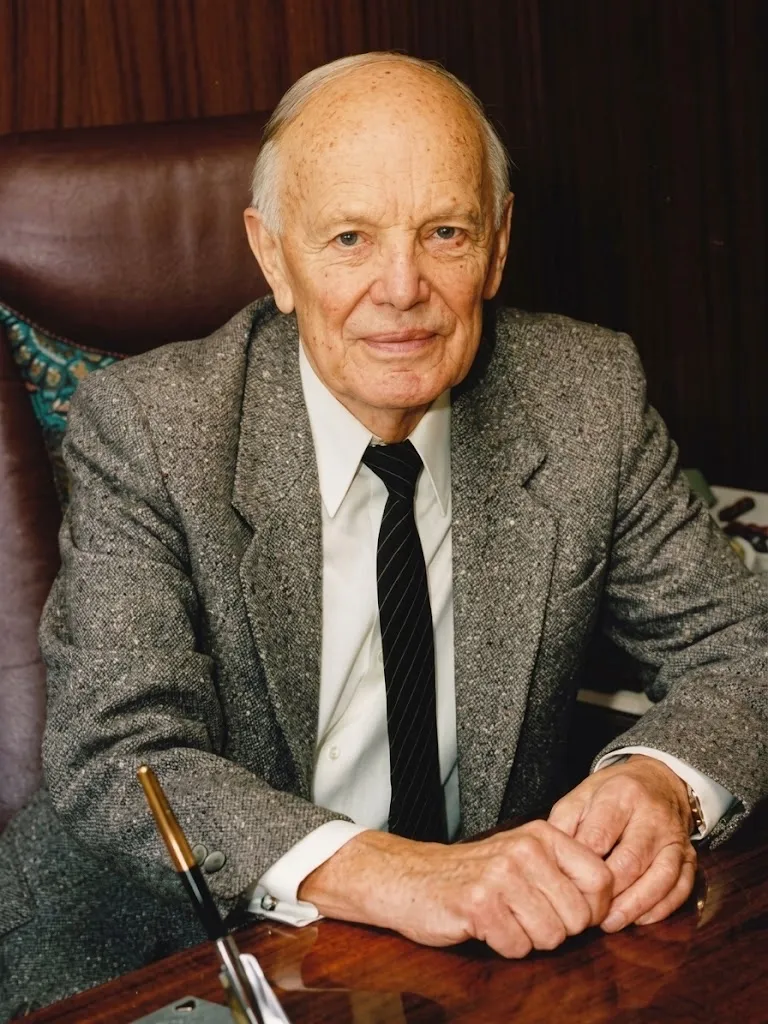
1908–1989
Valentyn Hlushko
Rocket engine designer
His engines lifted the first satellite and Yuri Gagarin into space. As a teenager in Odesa, Valentyn Hlushko wrote letters to Tsiolkovsky; later he ran the Soviet space program and built Energia and Buran. His part in Korolov’s 1938 case is still debated.
Key accomplishments
- The world’s first electrothermal rocket engine (1929–1933)
- The first Soviet liquid-fuel rocket engines (1930–1931)
- The RD-107 and RD-108 engines for the R-7 rocket, which put the first satellite and Gagarin’s Vostok into orbit
- The Energia launch vehicle and the reusable Buran spacecraft
- Led the building of the modular Mir space station
The violinist from Odesa who wrote to Tsiolkovsky
Valentyn Hlushko was born in 1908 in Odesa. In 1920–1922 he studied the violin at the Odesa Conservatory, and at 15 he began writing to the scientist Konstantin Tsiolkovsky about how rockets could open up space. In 1924 he finished a vocational school in Odesa and published a short piece called “The Conquest of the Moon by the Earth”. He then studied physics and mathematics at Leningrad University.
The first engines
From 1929 to 1933 Hlushko worked at the Gas Dynamics Laboratory in Leningrad. There he designed the world’s first electrothermal rocket engine and the first Soviet liquid-fuel rocket engines. From 1934 he worked at the Reactive Scientific Research Institute in Moscow, where his work with Serhii Korolov began.
Arrest and the prison design bureau
On 23 March 1938 Hlushko was arrested in Stalin’s terror. After two days in the Lubyanka cellars he signed a confession to membership of an anti-Soviet organization and spying for Germany. He later withdrew all his testimony and wrote letters to Stalin, Beria and Vyshinsky. In 1939 he was sentenced to eight years but kept working in NKVD design bureaus, where imprisoned engineers built rocket engines for aircraft. Korolov later worked in the Kazan bureau that Hlushko headed. Hlushko was released in 1944.
From Vostok to Buran
After the war Hlushko studied captured German rockets in Germany, and for decades he was chief designer of rocket engines. His engines powered Soviet long-range and space rockets, including the R-7 that put the first satellite and Gagarin’s spacecraft into orbit. In 1974 he took charge of the Energia association, which absorbed Korolov’s former design bureau. Under his leadership came the Energia launch vehicle, the Buran spacecraft and the Mir space station. Hlushko lived to see Buran launch; he died in Moscow in 1989.
Debates and assessments
Accounts of Hlushko’s role in Korolov’s 1938 arrest differ. The European Space Agency writes that, to reduce his own charges, Hlushko gave evidence against Korolov, which led to Korolov’s arrest in June 1938. Others stress that the NKVD extracted confessions under pressure, and the Ukrainian Week writes that Hlushko later withdrew all his testimony. The two designers’ relationship stayed difficult: in the early 1960s they argued fiercely over which propellants to use in the N1 super-heavy Moon rocket. Korolov could not reach an agreement with Hlushko on its engines and turned to another designer, Nikolai Kuznetsov. Some see Hlushko’s refusal as one reason for the N1’s failures. After he took over Energia in 1974, Hlushko shut the program down.
Why it matters today
Humanity’s road into space began partly with engines designed by Valentyn Hlushko of Odesa: they lifted the first satellite and the first crewed spacecraft into orbit. He was born and grew up in Odesa, worked mostly in russia and, it is said, always called himself Ukrainian. His life ran through a Stalin-era arrest and a prison design bureau, so his story is about great achievements and about the price paid for them in the USSR. And it all started with a teenager’s letters to Tsiolkovsky: a dream of space, backed by decades of engineering work, can take you very far.