c. 1555–1632
Pamvo Berynda
Lexicographer, author of the Lexicon
How do you explain the words of church books in the language people speak every day? Pamvo Berynda, a printer and poet, answered with his Lexicon (1627): a dictionary that explains almost 7,000 Church Slavonic and foreign words in the literary Ukrainian of his time.
Key accomplishments
- The Slavonic-Ruthenian Lexicon and Explanation of Names (1627): about 7,000 words explained in the Ukrainian of the time
- Prepared books at the Striatyn and Krylos presses: a Sluzhebnyk (1604), a Trebnyk and a Gospel (1606)
- Headed the Lviv Brotherhood press, where he also published his own Christmas verses (1616)
- Printer, editor and translator at the Kyiv Cave Monastery press
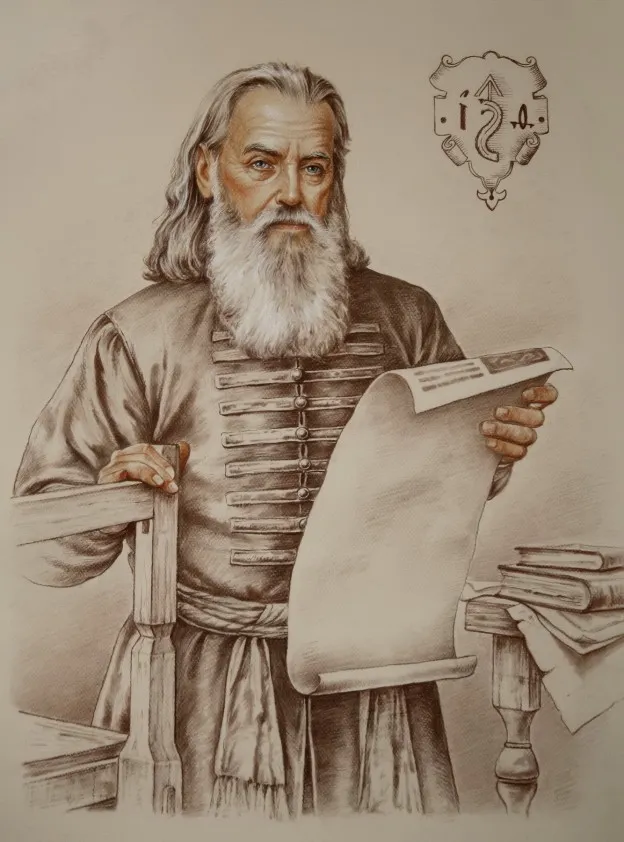
- Engraver: his engravings bear the monogram “ПБ”
A printer we know little about
Historians disagree about when and where Pamvo Berynda was born: near Sambir in one version, in Yezupil in the Carpathian foothills in another. We don’t even know where he studied. What we do know is that he had a fine command of Church Slavonic, Greek and Latin. In the early 17th century he prepared church books at Bishop Hedeon Balaban’s presses in Striatyn and Krylos: a Sluzhebnyk (1604), a Trebnyk and a Gospel (1606).
From Lviv to Kyiv
Berynda then headed the Lviv Brotherhood press. There he also published his own Christmas verses (1616), a dialogue performed by seven boys. In 1616 he was invited to the Kyiv Cave Monastery, and in time he moved there for good. At the monastery press he worked as printer, editor and translator, preparing a Book of Hours and the commentaries of John Chrysostom. He also cut engravings and signed them with the monogram “ПБ”.
A dictionary of 7,000 words
Church books were then written in Church Slavonic, and not everyone understood its words. In 1627 Berynda published, at his own expense, the Slavonic-Ruthenian Lexicon and Explanation of Names. It explains about 7,000 Church Slavonic and foreign words in the literary Ukrainian of the day. The first part is the dictionary itself; the second explains people’s names and place names. Among the sources Berynda drew words from was the Ostroh Bible, printed by Ivan Fedorov. Berynda wanted to revive the Church Slavonic book tradition as a counterweight to Polish and Catholic influence.
At rest in the monastery
Berynda died in Kyiv on 23 July 1632. He was buried at the Kyiv Cave Monastery.
Why it matters today
Pamvo Berynda wanted people who spoke the everyday language to understand the words of church books, and to make that happen he published his Lexicon at his own expense. It showed that the literary Ukrainian of his day could explain both Church Slavonic and foreign words. Linguists still study it, because it shows what written Ukrainian looked like in the early 17th century. Anyone who looks up an unfamiliar word in a dictionary today is doing what Berynda offered his readers almost four hundred years ago.